
Wild Cherry: Mind the season, Mind your Symptoms
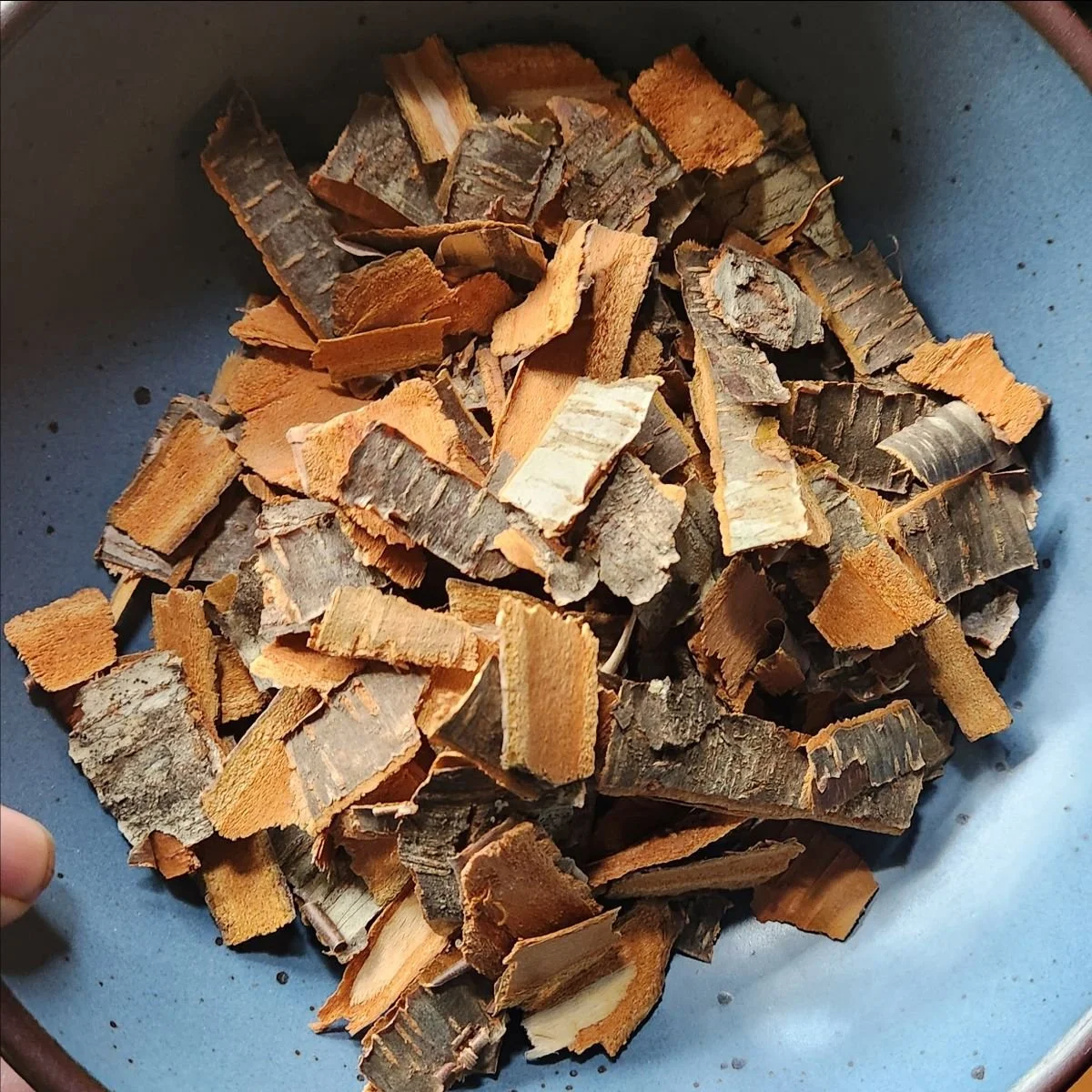
Wild Cherry (Prunus serotina) bark, dried
This summer I came down with a mild cold, which is not unusual. What was unusual was the long drawn out lingering cough I had: weeks of spasming, non-productive coughing fits, sometimes multiple times a day. For a while, I reached for the wrong remedies. I thought my cough meant I had lingering gunk in my lungs that I needed to release, so I reached for stimulating expectorants like Elecampane and Spikenard. These warming, stimulating remedies help me so much in the winter that I reached for them automatically without considering the season or the specifics of my cough.
The stimulating expectorants not only had no effect, they seemed to exacerbate my cough, which makes sense when you consider their mechanism of action. Finally, after a particularly bad coughing fit, I slowed down and thought more about my condition. My cough was hot, spasming, and dry. The summer heat was exacerbating my symptoms as I struggled to stay well-hydrated. This all meant I would benefit from cooling, relaxing herbs with an affinity for the respiratory system, and that my dry bronchial passages could also use some demulcent medicine.
With this in mind, I began alternating cold infusions of Cherry bark and Marshmallow root powder. Cherry is a cooling relaxing nervine and lung remedy well-indicated for my condition, though it is a bit dry. Marshmallow is a soothing demulcent herb which balances Cherry's dryness. Both have an affinity for the respiratory system. Two days of alternating cold infusions saw an end to my racking cough. Drinking multiple cold infusions a day also meant I was drinking more than enough water. Dehydration can be an underlying factor for dry coughs, so the water too has a remedial effect.
The lesson here is to always consider the time of year, the qualities of the symptoms, and the qualities of the herbs. Matching herbal energetics to our symptom pattern is key for successful herbal care.
Meeting the tree
Here in the Southeast, when we refer to cherry bark medicine, we are usually referring to either Prunus serotina, Black Cherry, or Prunus virginiana, called Chokecherry. You can learn to identify these trees on the Virginia Tech Dendrology website. Generally, you should look for reddish brown bark with stripes called lenticels.
These species of cherry are native but weedy, making them an abundant source of medicine. They are early succession trees in meadows and clearings, so if you want your meadow to remain a meadow, harvesting Cherry saplings is part of the work. These trees coppice easily as well, so if you cut them they will regrow and will be ready to harvest in a few years. We have a few saplings in our herb garden we harvest from regularly.
Cherry medicine
So what does Cherry do? We herbalists need to be careful not to center human needs when we think of our plant friends. So first, let's consider the important role wild cherry trees play in the ecosystems we inhabit. Prunus serotina and P. virginiana are considered keystone ecological species. They are hosts to over 200 species of butterflies and moths. Over 70 species of birds and many species of mammals, including black bears, foxes, and possums, consume their fruit. Their flowers feed too many pollinators to count.
As I mentioned earlier, these trees are early succession species who help turn meadows and fields into forests. They stabilize the soil and provide shade for plants who would prefer less sunshine as the forest community of plants begins to gather.
Back to the medicinal qualities of Cherry. There are many species of cherry. While we have only worked with Prunus serotina and P. virginiana, any species of cherry that has an almondy smell when you scratch the bark likely has similar medicinal attributes. That almond smell is tied to these trees' medicinal virtues. They contain constituents called cyanogenic glycosides. These constituents help relax the lung but can also be toxic if they break down and form hydrogen cyanide — not likely to happen with standard herbal uses. If you want to learn more about cyanogenic glycosides, here is an info sheet Dave Meesters made on safety and risk with these compounds.
The simplest way to think about handling Cherry or Peach or any other plant that contains these compounds is to either tincture them fresh or dry them completely for tea or tincture. If the plant matter is fresh or fully dry, it is safe. If it is in between (wilted leaves or half-dried bark), then the leaves or bark will contain more cyanide. Don't let this potential scare you. Cherry is potent abundant medicine, easy to work with and worth getting to know.
Wild Cherry is cool, dry and relaxing and has an affinity for the respiratory system. This means Cherry can help with overly active (excited) spasming (tense) lungs. Cherry eases so many kinds of coughs: lingering coughs, wracking coughs, coughs that keep you up at night, dry hectic coughs, irritation in the respiratory tract, unproductive coughs, coughs that disrupt sleep, and coughs associated with hot weather.
Preparation and dosage
Cold infusion, especially helpful for coughs that keep one up at night: 2 to 6 ounces 3-5 x a day
Tincture of dry bark: 1:5, 60% ethanol, 30% water, 10% glycerin
Tincture of fresh bark: 1:2 at 80%. For both fresh and dry tincture, dosage is 30 to 90 drops up to 4x a day.
Syrup made with the cold infusion or with infused honey.
As you might expect, given the potent constituents in Cherry bark, one should use caution when working with this herb for extended periods of time. Long term use can suppress digestion. If using daily, do not take Cherry for more than a month at a time.
Making a cold infusion
The simplest way to make a cold infusion is to put a handful of ground powdered herb in a pint jar and fill with water. Let sit for 4-6 hours, strain, and drink. You can also suspend the herb in a cotton muslin tea bag. We primarily use this method for demulcent roots and aromatic barks. With Cherry, cold infusion also extracts fewer tannins, so the tea is less astringent.
If you want to be more precise, you can use the medicinal strength dosage method (alter the quantities as desired but keep the proportions):
Moisten one ounce by weight of ground herb.
Place in a cotton muslin tea bag and suspend in one quart of room temperature water.
Let stand overnight or for 4 to 6 hours.
Remove herb, squeeze.
Add water to make 32 ounces.
Strong cherry cough syrup
One of our favorite cherry bark syrup recipes is from Cook's Physiomedical Dispensatory, first published in 1869:
Moisten five ounces of coarsely powdered prunus with cold water, and let it stand twelve hours (or six hours in warm weather); transfer to a percolation cone, and gradually add water until a pint of liquid has been obtained; to this add two pounds of refined sugar, in a bottle, and shake occasionally till the sugar is dissolved.
Let cool and store in a cold place, ideally a refrigerator. Take 1-3 teaspoons as needed.